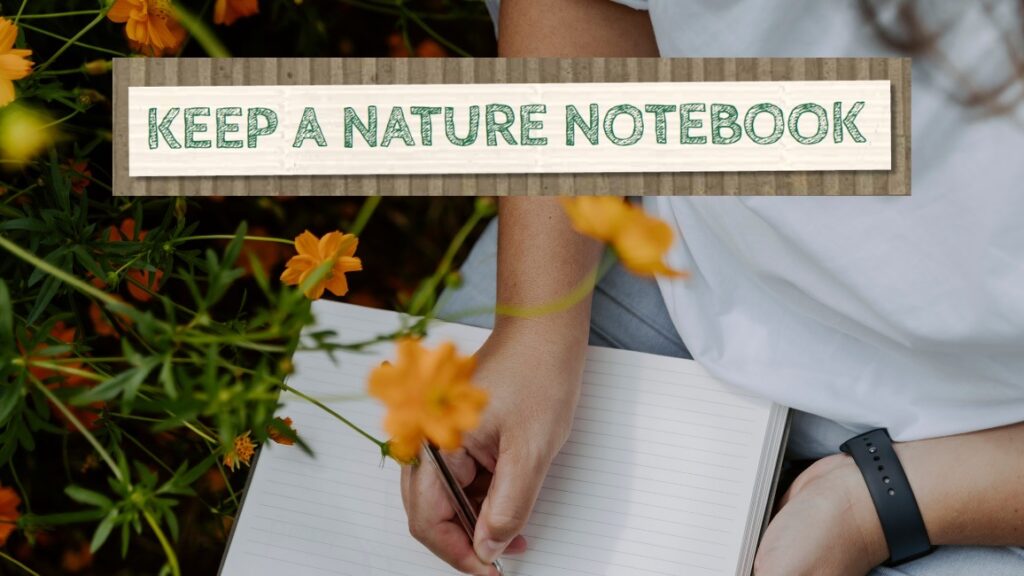
Have you ever kept a journal—a book where you write down what you do and how you feel each day? Here’s another idea: Keep a nature journal! You can use your special notebook to keep track of what you see, hear, think, and feel when you’re outside in nature.
Time: 15-30 minutes per entry
Difficulty Level: Easy
Materials
- Notebook (lined for writing, blank for drawing, or a combination)
- Pen, pencil, or colored pencils
- Optional: tape or glue for attaching leaves, feathers, or photos
- Optional: magnifying glass for close-up observations
- Optional: field guide for identifying plants and animals
What to Do
- Pick a spot. Go outside. It can be your backyard, a park bench, a trail, or even a window with a view of trees or sky. You don’t need to hike deep into the woods. Nature is everywhere.
- Look and listen. What sounds do you hear? What do you smell? Can you see any animals? If so, what kind and what are they doing? With words or drawings, answer these—or other—questions in your nature journal.
- Pick one thing to focus on. A bird, a flower, a cloud, a bug, a tree. Look at it closely. Notice details you wouldn’t normally see: color, shape, size, texture, movement.
- Show and tell. When you draw an animal or plant, pay attention to the details. Does a bird you see have stripes on its wings or spots on its head? How many petals are on a flower you might find? And how are the leaves arranged on that plant you see? Be sure to take note of size and color, and write down when and where you saw the plant or animal.
- Tape or glue stuff in. Take photos with a phone or camera, print them out, and glue them into your journal. You can also tape in natural things you find, such as leaves or seeds.
- Look it up. Not sure about everything you saw outside? When you get back home, the detective work begins. Your job will be easier if you have a field guide for your area, but you can also find a lot of good information online. Some phone apps will identify plants or animals from the photos you take. (Doublecheck what your phone tells you, though—those IDs aren’t always correct.)
What if you can’t find the name of something? That’s OK, because you’ll learn what parts of the plant or animal to look at more carefully the next time you see it. You can have a lot of fun keeping a nature journal. Why don’t YOU give it a try?
Tips
- Start small. One page per week is plenty. The goal is noticing, not filling pages.
- Ages 4-6: Draw a picture and tell a grownup one thing they noticed. The grownup writes it down.
- Ages 7+: Keep a weekly log with date, location, weather, and at least one drawing and one observation.
- Use questions. “Why is this leaf turning red?” or “Where does this bird go at night?” are great notebook entries even if you don’t know the answers yet.
- No backyard? Watch birds from a window, observe clouds, or study the plants growing in sidewalk cracks. Nature journals work in cities, too.